Ethiopia vs Indonesia coffee: the same exports by different paths.
Ethiopia vs Indonesia coffee: Ethiopia's output rose 48 percent in five years, Indonesia's 7.6 percent, and Ethiopia now ships more green beans. USDA figures.
Indonesia and Ethiopia are forecast to ship almost the same green coffee in 2026/27, 7.0 and 7.1 million bags. They got there by different paths. Over five USDA years Ethiopia's output rose 48 percent, from 8.15 to 12.1 million bags. Indonesia's rose 7.6 percent, from 10.58 to 11.38 million. Ethiopia's bean exports have now topped Indonesia's in three of the last four USDA years. Figures are thousand 60 kg bags.
Six years, two origins
| Year | Indonesia Robusta | Indonesia Arabica | Robusta share | Ethiopia, all Arabica |
|---|---|---|---|---|
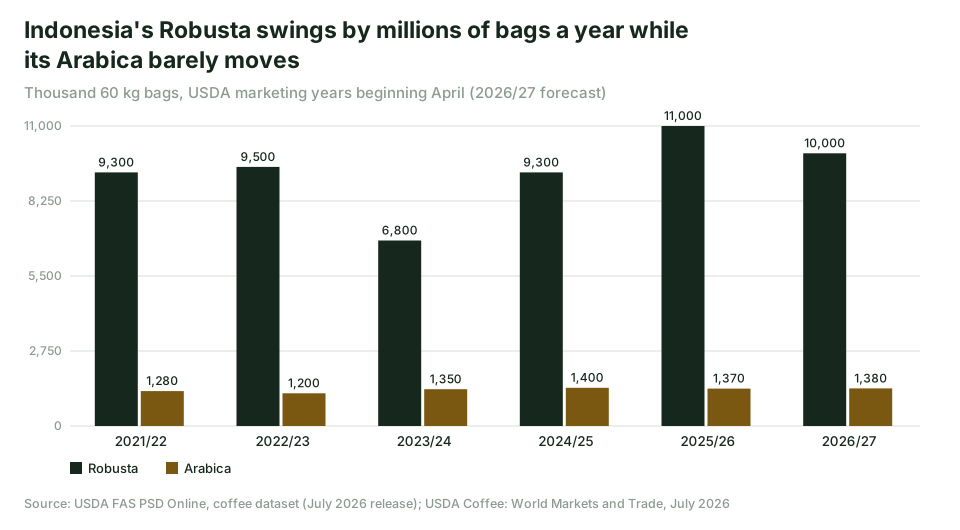
| 2021/22 | 9,300 | 1,280 | 87.9 percent | 8,150 |
| 2022/23 | 9,500 | 1,200 | 88.8 percent | 7,300 |
| 2023/24 | 6,800 | 1,350 | 83.4 percent | 9,130 |
| 2024/25 | 9,300 | 1,400 | 86.9 percent | 11,460 |
| 2025/26 | 11,000 | 1,370 | 88.9 percent | 11,560 |
| 2026/27 | 10,000 | 1,380 | 87.9 percent | 12,100 |
The share column is our arithmetic. Indonesia's species mix ends where it started, at 87.9 percent Robusta. What moves is the Robusta tonnage: down 2.7 million bags in one year, up 2.5 million the next, then up 1.7 million and down 1.0 million. Arabica never moved more than 150,000 bags in a year.
Lowland or highland: two USDA accounts
Both USDA documents put the 2026/27 Robusta loss at 1.0 million bags and blame rain at flowering. They disagree on where. The July World Markets and Trade report names the lowland areas of Southern Sumatra and Java, where about 75 percent is grown. The Jakarta office's May Coffee Annual names lower yields in the highland areas of southern Sumatra and in parts of Java. It says southern Sumatra's Robusta is about 60 percent highland and 40 percent lowland. In Central Java, farmers reported rain that knocked flowers off and washed pollen away.
We give more weight to the Jakarta report on location, because it is the field report and breaks output down by area. On size and cause the two agree.
Arabica had its own problem. Floods in Aceh and North Sumatra in late November 2025 damaged roads, bridges, mills and warehouses. The Jakarta office cut 2025/26 Arabica to 1.37 million bags from 1.45 million, says transport costs reportedly doubled, and notes that local government counted at least 12,000 hectares of damaged plantation in Aceh. It also cites the national weather agency, BMKG, expecting a drier and longer 2026 dry season as El Niño strengthens.
Buyers of Indonesian coffee
The Jakarta report puts Belgium, Germany, the United States, Egypt and Algeria among the largest buyers. Shipments to Europe rose 72 percent to 2.4 million bags in 2025/26. The United States ranked third at 797,000 bags, and 60 to 80 percent of what it takes is Arabica, shipped mostly through Belawan in North Sumatra. Statistics Indonesia (BPS) data for January to June 2025, published on the government's Indonesia Baik portal, give a calendar view: 206.7 million kg exported, led by the United States at 30.8 million kg and Belgium at 30.3 million kg, then Egypt and Germany. Indonesia also imports. Vietnam supplied roughly 55 to 68 percent of its green imports over recent years.
What each grows more of
Indonesia wins on Robusta, 10.0 million bags against none in Ethiopia. It also drinks almost as much as Ethiopia at home, 4.83 million bags against 5.0 million. Ethiopia wins on Arabica, 12.1 million bags against 1.38 million, and on growth. The USDA attributes Ethiopia's rise to higher area and yield, with over half the cultivated area replaced by higher yielding varieties in four years.
A caution on timing: these are USDA balance sheets on different calendars, April to March for Indonesia and October to September for Ethiopia, so a single year's comparison is approximate.
Before booking Indonesian coffee
- Compare the USDA's next Indonesia update with the 10.0 million bag Robusta forecast. The highland harvest ran June to August 2026, so that crop is now known locally.
- Watch the Lampung Robusta spot series from Bappebti, reprinted by the USDA. It read 66,661 rupiah per kg in April 2026 against 98,659 a year earlier.
- For Sumatran Arabica, ask whether the Aceh main crop, normally October to November, is on time. Last season it slipped into early 2026.
- Ask which crop year an April 2027 shipment belongs to. Under the April start it is a new crop.
Kaffa Bridge works only in Ethiopia, as the buyer's agent, and cannot help with Sumatran lots. Ethiopian Arabica bought through it starts at one full container load, priced on enquiry FOB Djibouti or CFR your port.