Ethiopia vs Brazil coffee: Brazil exports its growth, Ethiopia shares it.
Ethiopia vs Brazil coffee in USDA data: 41 percent of Ethiopia's extra crop since 2021/22 stayed at home, against almost none of Brazil's. What to check.
Since 2021/22, about 41 percent of Ethiopia's extra coffee has stayed in Ethiopia. The USDA forecasts Ethiopia's 2026/27 crop 3.95 million bags above 2021/22, and its home consumption 1.64 million bags above. Over the same seasons Brazil's crop grew 13.8 million bags while its home consumption rose 50,000 bags. Brazil's growth goes to export and stocks. Ethiopia's is shared with its own drinkers. For a buyer, that changes the question. With Brazil, the number to watch is the size of the crop. With Ethiopia, it is the crop minus a home market that is growing as fast as the harvest.
Five seasons apart
| Thousand 60 kg bags | Brazil 2021/22 | Brazil 2026/27 | Ethiopia 2021/22 | Ethiopia 2026/27 |
|---|---|---|---|---|
| Production | 58,100 | 71,900 | 8,150 | 12,100 |
| Arabica | 36,400 | 47,500 | 8,150 | 12,100 |
| Bean exports | 35,576 | 45,000 | 4,831 | 7,100 |
| Domestic consumption | 22,340 | 22,390 | 3,364 | 5,000 |
| Ending stocks | 540 | 4,425 | 90 | 145 |
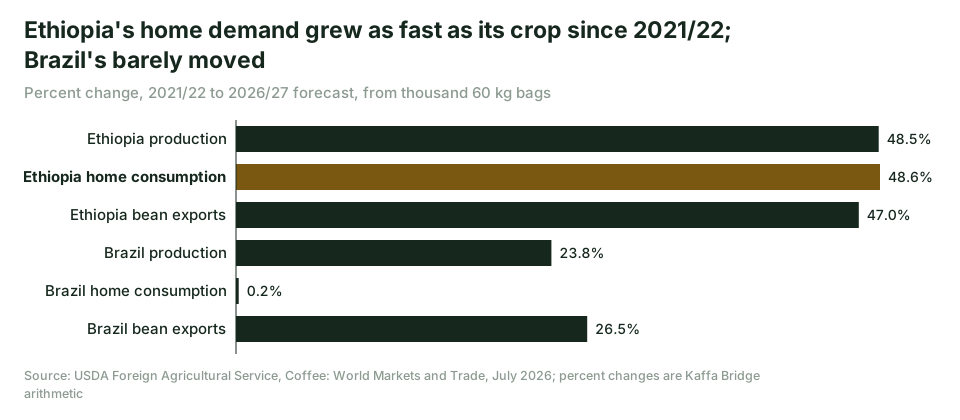
Both origins export a similar share of the crop as beans: 62.6 percent for Brazil and 58.7 percent for Ethiopia in 2026/27, our arithmetic. The difference is direction. Brazil's share has ranged from 51.4 to 65.0 percent since 2021/22 and moves with the crop. Ethiopia's peaked at 64.7 percent in 2024/25 and has fallen two seasons running as home use climbed from 4.0 to 5.0 million bags.
The USDA has already shown what this means in practice. It cut Ethiopia's 2025/26 bean exports by over 800,000 bags to 6.9 million, and gave higher-than-anticipated domestic consumption as the reason. The full Ethiopian balance shows where those bags went.
How steady each crop has been
In the USDA series, Ethiopian Arabica fell in 2 of the last 21 seasons. Brazilian Arabica fell in 11. Ethiopia's average year-on-year move was 0.46 million bags; Brazil's was 7.0 million. In 10 of Brazil's 11 down years, Ethiopia's crop rose or held level.
That steadiness has a ceiling. Ethiopia's largest single-season gain was 2.3 million bags, in 2024/25, about a third of a normal Brazilian swing. Ethiopia can steady a programme. It cannot stand in for Brazil's volume.
What Brazil does better
- Scale. 71.9 million bags in 2026/27, about 5.9 times Ethiopia's crop, and a record 45.0 million bags of bean exports.
- Robusta in the same origin. Brazil grows 24.4 million bags of Robusta. Ethiopia grows none in the USDA figures.
- Market reach. Cecafe reports exports to 120 countries from January to September 2026. The United States took 3.805 million bags (13.1 percent), Germany 3.307 million (11.4 percent), then Italy 2.597 million, Belgium 2.463 million and Japan 1.451 million.
What Ethiopia adds
Ethiopia is an Arabica-only origin whose output has grown 48.5 percent in five seasons. The USDA attributes recent growth to replacing over half of the cultivated area with higher-yielding varieties. Lots can be bought by zone, such as Yirgacheffe, Sidama and Guji. We make no claim here about which origin tastes better. That belongs on your cupping table.
One limit applies to every figure above. Bean exports exclude roasted and soluble coffee, and that matters more for Brazil, which ships a further 4.0 million bags of soluble in 2026/27.
Before you place the next contract
- Ethiopia's export line in the USDA's 16 December 2026 release. Compare it with 7.1 million bags. A cut with a stable crop means home demand again.
- Ethiopian home consumption. The July figure is 5.0 million bags. If it rises again, plan on less exportable coffee than the crop headline suggests.
- Brazil's buyer mix. Cecafe's next monthly report will show whether the United States, at 3.805 million bags to September, stays ahead of Germany.
Kaffa Bridge has no Brazilian coffee to offer; it acts for buyers in Ethiopia only. Ethiopian lots are priced on enquiry, FOB Djibouti or CFR your port, from one full container load.